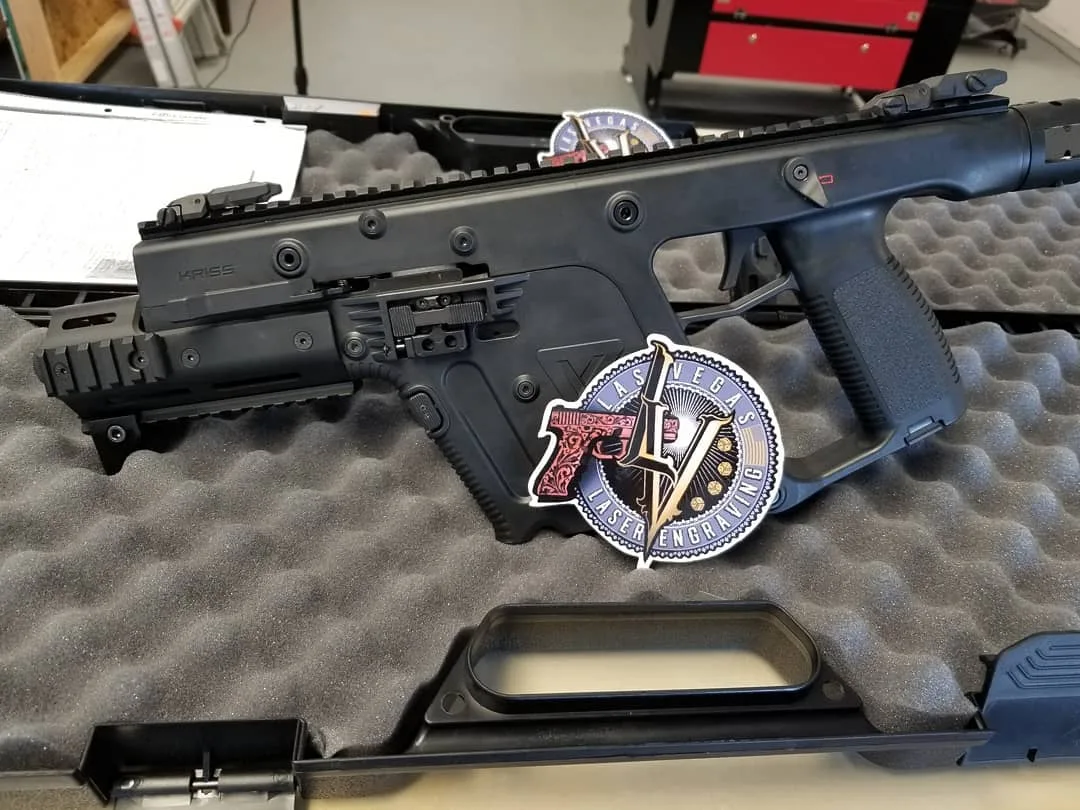
If you have been on any gun forum this year, you have seen someone claim SBR engraving requirements are dead. You have also seen someone swear nothing has changed and you will lose your rifle if you skip it.
We do NFA markings every week and we hold an 07 FFL with SOT status. Here is the actual situation, pulled from the regulation, the ATF’s own handbook, and the ATF’s own proposal.
The Short Answer on SBR Engraving Requirements
As of today, you still have to engrave. Nothing has changed yet.
The ATF published a proposed rule on May 6, 2026 that would let makers adopt the markings already on a factory firearm. The comment period closed July 6, 2026. No final rule has been issued. Until one is, the current requirement stands.
If it does go final, it would eliminate engraving entirely for the most common Form 1 build: taking an existing factory rifle and shortening the barrel. That is a bigger change than most coverage suggests. It would not, however, help anyone building on an unserialized receiver.
What you actually have to engrave right now
This is where almost every article on the internet gets it wrong, including some written by people who should know better.
For a Form 1 SBR built from an existing, serialized factory rifle, you engrave:
- Your name, or a recognized abbreviation
- The city and State where you made the firearm
- The caliber, but only if it is not already marked on the gun
- The model, but only if it is not already marked and a designation exists
You do not engrave a new serial number.
The existing factory serial number carries over. The ATF’s own NFA Handbook, section 6.2.1, says it directly:
“If an existing firearm is being used in the making of the NFA weapon, and that firearm is serialized, the existing serial number should be used (unless it duplicates a serial number already used by the maker on Form 1) and entered in Block 4(g).”
That existing serial goes in Block 4(g) of your Form 1. It stays on the gun. You add your identity to it. In practice, on a modern factory rifle that already has caliber and model marked, that means you are engraving three things: name, city, State. That is the whole job.
If you are building from raw materials or an unserialized receiver, it is a different story. Skip down to that section.
Depth and print size, the part that actually fails inspection
27 CFR 479.102 sets the physical spec, and this is where DIY jobs come apart:
- Minimum depth: .003 inch for all required markings. Measured from the flat surface of the metal, not from the peaks or ridges.
- Minimum print size: 1/16 inch for the serial number and any associated license number. Measured between the latitudinal ends of the character impression bottoms.
- Not susceptible of being readily obliterated, altered, or removed.
- Conspicuous. The regulation defines this as easily seen with the naked eye during normal handling, and unobstructed by other markings once the weapon is assembled.
- Roman letters and Arabic numerals only. Hyphens allowed.
Three thousandths of an inch does not sound like much until you try to hit it with a rotary tool on your bench. Too shallow and you are not compliant. Too deep on a thin-walled receiver and you have a different problem.
One more myth worth killing
Barrel length is not a required marking. It goes in Block 4(e) of your Form 1. It does not go on your receiver. Plenty of people engrave it anyway and there is no harm in it, but the regulation does not ask for it.
The tension nobody writes about
Here is something genuinely strange, and it is the reason the forums are such a mess.
The regulation at 27 CFR 479.102(a)(1) says a maker must place “an individual serial number” on the firearm. Read literally, that means a new serial number, every time.
The ATF’s own handbook says to use the existing one.
The industry has followed the handbook for decades. Form 1s get approved on that basis constantly. We have marked a great many of these and we have never engraved a serial number on a factory gun.
The ATF acknowledged the conflict in this very proposal. In its own words:
“§ 479.102 does not allow a maker to adopt the manufacturer’s markings already stamped on the maker’s GCA firearm… Instead, pursuant to § 479.102(a)(1), a maker must place on the firearm a new serial number…”
So the ATF is on record saying its regulation requires something the practice has never required. The proposed rule is, in part, the ATF cleaning up its own inconsistency.
What this means for you practically: follow established practice and your engraver’s guidance, keep your Form 1 paperwork consistent with what is on the metal, and understand that the marking rules are actively being rewritten right now.
What the proposed rule would change
The proposal is Docket No. ATF-2026-0005, ATF No. 2025R-17P, RIN 1140-AA70, titled “Allowing Makers To Adopt Certain Markings for National Firearms Act Firearms.”
Section 479.102(b)(3) already lets manufacturers and importers adopt markings already on a firearm. Makers were never included. The rule adds a new subsection:
(iv) Makers. Makers that remanufacture or alter an existing firearm may adopt the serial number or other identifying markings previously placed on the firearm if the markings otherwise meet the requirements of this section.
Note the phrase “or other identifying markings.” That is not just the serial number. That includes the original manufacturer’s name, city, and State.
Which means: if your factory rifle already carries the manufacturer’s name, city, State, and serial number, you could adopt all of it and engrave nothing at all.
The ATF was blunt about why. Straight from the proposal:
“many makers do not have the necessary equipment to stamp their own firearms in a manner that satisfies § 479.102, thus imposing a burden to pay for services from a gunsmith or other individual to meet such requirements.”
We will be honest with you, since we are the “other individual” in that sentence. If this rule finalizes, most of our Form 1 engraving work goes away. We would rather tell you that plainly than sell you something you are about to not need.
Who would still have to engrave
The ATF drew a clear line. The rule would not touch anyone who makes an NFA firearm from raw materials not regulated by the Gun Control Act, because those firearms have no existing markings to adopt.
You would still need full marking if you are building on:
- An 80% or unfinished receiver
- A privately made firearm with no factory serial number
- Anything machined from raw stock
If your build starts with no serial number on it, nothing in this proposal helps you. You get the complete requirement: a serial number you assign, your name, city, State, plus model and caliber, all at .003 inch with the serial at 1/16 inch minimum.
Worth knowing on assigned serials: the handbook notes that alpha characters alone will not be accepted. If you want to use a name, include at least one numeral. A common approach is your initials followed by four or more digits.
The catch, even if the rule finalizes
Adoption is only permitted “if the markings otherwise meet the requirements of this section.”
A lot of factory markings do not.
Modern manufacturers frequently use shallow laser etching for model and caliber information. It looks sharp. It photographs well. It is often nowhere near .003 inch deep. Some polymer and thin-wall receivers carry markings that would not pass a depth gauge.
So even in a post-rule world, the honest answer for a fair number of builds is going to be: measure first. If the existing markings do not clear the standard, you cannot adopt them, and you are engraving anyway.
We have a depth gauge and we will tell you straight whether your receiver clears it. That answer costs you nothing.
Where the rule stands today
| Item | Status |
|---|---|
| Published | May 6, 2026 (91 FR 24466) |
| Comment period closed | July 6, 2026 |
| Docket | ATF-2026-0005 (ATF No. 2025R-17P) |
| RIN | 1140-AA70 |
| Final rule issued | No |
| Current requirement | Still in effect |
A proposed rule is a proposal. The ATF now reviews comments and decides whether to finalize it, revise it, or drop it. There is no published deadline. It could land next month, sit for a year, or come out looking different than proposed.
Do not plan a build around a rule that does not exist yet.
What happens if you skip it
An NFA firearm that is not marked as required is not properly identified. NFA violations carry real exposure under 26 U.S.C. 5871: fines up to $10,000, up to ten years imprisonment, or both. The firearm is subject to forfeiture under 26 U.S.C. 5872.
Nobody thinks the ATF is hunting hobbyists over engraving depth. But you filed a federal form, you signed it, and you are in a federal registry. The marking is what ties the paperwork to the metal. It is not the corner to cut.
What to do right now
Form 1 approved, not engraved yet? Engrave it. The requirement is live. Betting on a proposed rule against a ten year exposure is a bad trade.
About to file? File, and plan on engraving. If the rule finalizes before your stamp comes back, you saved a step. If not, you were ready.
Building on an unserialized receiver? The proposal does not help you. Plan on full marking either way.
Already engraved and feeling burned? Don’t. Your rifle is compliant today and stays compliant no matter what the ATF does next. There is no penalty for correct markings.
Frequently asked questions
Is the SBR engraving requirement going away?
Possibly, for factory-built rifles. The ATF proposed letting makers adopt the markings already on an existing firearm, which would mean no new engraving at all on a serialized factory gun. The comment period closed July 6, 2026 and no final rule has been issued. The requirement is still in effect today.
Do I have to engrave my SBR in 2026?
Yes. If your Form 1 is approved and you have made the firearm, the marking requirement applies.
What has to be engraved on a Form 1 SBR?
Your name, and the city and State where you made it. Also caliber and model if those are not already marked on the firearm. You do not engrave a new serial number if the gun is already serialized. Per the ATF’s NFA Handbook, the existing factory serial number is used and entered in Block 4(g) of your Form 1.
Do I need to engrave a new serial number on my SBR?
No, not if you are building from an existing serialized firearm. The factory serial carries over. You only assign and engrave a serial number if you are building from raw materials or an unserialized receiver.
Does barrel length need to be engraved?
No. Barrel length is reported on your Form 1, not marked on the receiver.
How deep does NFA engraving have to be?
A minimum of .003 inch, measured from the flat surface of the metal rather than from peaks or ridges. Serial numbers must also be at least 1/16 inch in print size.
What is the penalty for not engraving an SBR?
NFA violations under 26 U.S.C. 5871 carry fines up to $10,000, imprisonment up to ten years, or both, and the firearm is subject to forfeiture under 26 U.S.C. 5872. Talk to a firearms attorney about your specific situation.
How much does SBR engraving cost?
We charge $50 for NFA-compliant markings, done while you wait, usually in under 20 minutes. No appointment needed.
Get it marked right
We are a Federal Firearms Licensee with SOT status and we do NFA-compliant markings every week. $50, done while you wait, generally under 20 minutes. No appointment necessary.
Not local? Ship us your upper or receiver directly. Include a contents list with serial numbers, your name and contact information, a short description of the work, and a prepaid return label. UPS or FedEx only, no USPS.
Bring it in, or call or text 702-201-1822 and we will tell you exactly what your receiver needs. If your existing markings already clear the depth requirement, we will tell you that too, even when the answer is that you do not need us.
We do what other shops won’t. That includes giving you a straight answer.
LV Laser Engraving
6985 W Sahara Ave, Suite 104, Las Vegas, NV 89117
702-201-1822
This article covers federal marking requirements under 27 CFR 479.102, ATF’s National Firearms Act Handbook, and the ATF’s proposed rule under Docket ATF-2026-0005 (RIN 1140-AA70), current as of August 4, 2026. It is provided for general information and is not legal advice. Regulations change. Verify current requirements at atf.gov or consult a qualified firearms attorney before making decisions about your build.